 Protest Room
Case 10
Updated: 2026-03-24
If a boat hails ‘Room to tack’ when she is neither approaching an obstruction nor sailing close-hauled or above, she breaks rule 20.1. The hailed boat is required to respond even if the hail breaks rule 20.1.
Facts 1
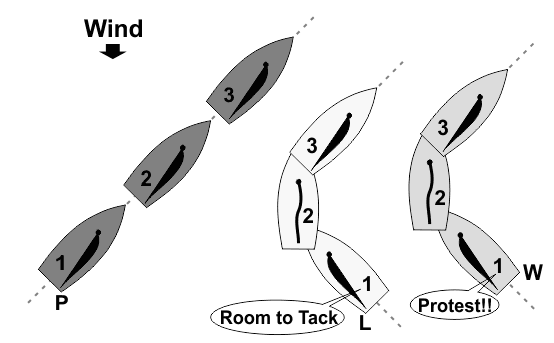
L and W are close-hauled on starboard tack. L is on a collision course with P, a boat racing, close-hauled on port tack. L hails ‘Room to tack’. W responds and protests.
Question 1
How does rule 20 apply to this situation?
Answer 1
Although there is risk of collision between L and P, P is not an obstruction to L and W because neither L nor W is required to keep clear of her.
At the time L hails for room to tack, she is not approaching an obstruction and she breaks rule 20.1(a).
Rule 20.2(b) requires W to respond to L’s hail even if the requirements of rule 20.1 are not met. Therefore, W must either tack as soon as possible or hail ‘You tack’ and then give room for L to tack and avoid her. When W responds, L must tack as soon as possible. W responds by tacking and breaks no rule.
Facts 2
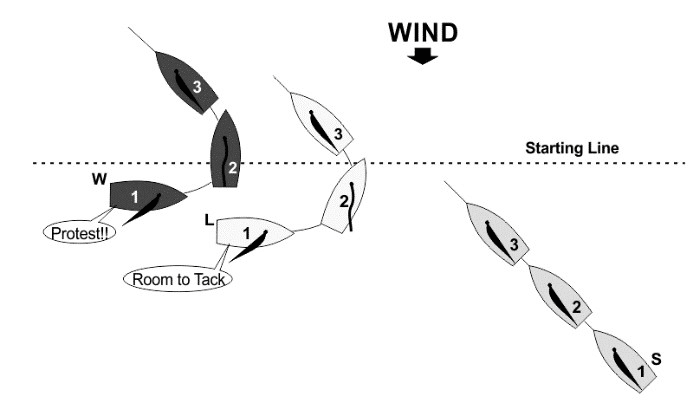
L and W are reaching along the starting line on port tack. L is on a collision course with S, approaching the line close-hauled on starboard tack. L hails ‘Room to tack’. W responds and protests.
Question 2
How does rule 20 apply to this situation?
Answer 2
S is an obstruction to both W and L.
At the time L hails for room to tack, she is approaching an obstruction and will need to make a substantial course change to avoid it. However, because she is not sailing close-hauled or above, she breaks rule 20.1(b).
As in Answer 1, rule 20.2(b) requires W to respond to the hail even if the requirements of rule 20.1 are not met. Therefore, W must either tack as soon as possible or hail ‘You tack’ and then give room for L to tack and avoid her. W responds by tacking and breaks no rule. If L fails to tack, and for example sails astern of S, she also breaks rule 20.2(d).