 Protest Room
Case 2
Updated: 2026-03-24
This case covers a situation involving two boats at a downwind mark in which a boat clear astern reaches the zone before a boat clear ahead. In that situation the boat clear ahead is required by rule 18.2(a)(2) to give mark-room to the boat clear astern.
Facts
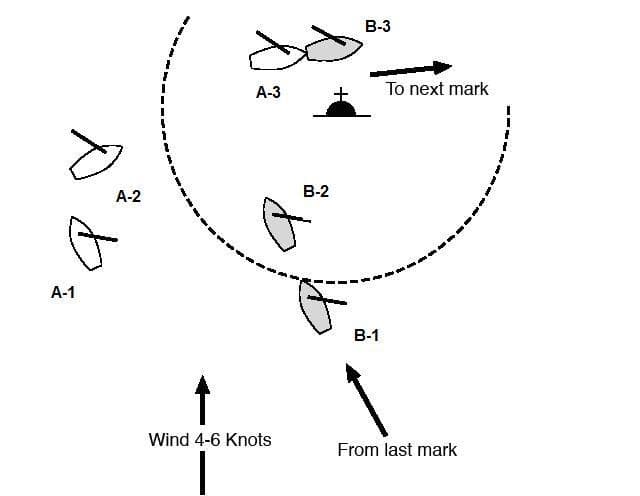
A and B were both on port tack, reaching to a mark to be left to starboard. The wind was light. At position 1, when B reached the zone, A was clear ahead of B but four-and-a-half hull lengths from the mark. Between positions 1 and 2 A gybed and headed to the mark, becoming overlapped outside B. Then B gybed and headed to the mark. Between positions 2 and 3, after B had gybed and turned towards the mark, she became clear ahead of A. When B first became clear ahead of A there was about one-half of a hull length of open water between the boats. A few seconds after B became clear ahead, A, who was moving faster, struck B on the transom. There was no damage or injury.
B protested A under rule 12 and 18.2(a)(2). A was disqualified and she appealed.
Decision
At position 1, B was the first of the two to reach the zone, even though she was clear astern of A. Therefore, rule 18.2(a)(2) applied, and it required A, which had not reached the zone at that moment, to give mark-room to B, which was room for B to sail to and past the mark on the required side in a seamanlike way.
There are no facts that suggest B sailed outside of the mark-room to which she was entitled after position 1, or that she broke rule 10 while on port tack or rule 15 after gybing and becoming clear ahead of A. If she were to have broken rule 10 or rule 15, she would be exonerated by rule 43.1(b) for those breaches. When A hit B’s transom, she obviously was not keeping clear of B, and so it was proper to disqualify A for breaking rule 12. A also broke rule 18.2(a)(2) when she hit B’s transom because at that moment A was not giving B mark-room. Finally, A also broke rule 14(a) because it was possible for her to bear off slightly and avoid the contact with B.
After it became clear that A was not going to keep clear of B, it was not reasonably possible for B to avoid the contact. However, even if B could have avoided the contact but did not do so, she would have been exonerated by rule 43.1(c) because she was the right-of-way boat and the contact did not cause damage or injury.
The appeal is dismissed, and the protest committee’s decision is upheld. Finally, A broke rules 12, 14(a) and 18.2(a)(2) and she remains disqualified.