 Protest Room
Case 49
Updated: 2026-03-27
When two protests arise from the same incident, or from very closely connected incidents, they should be heard together in the presence of representatives of all the boats involved.
Facts
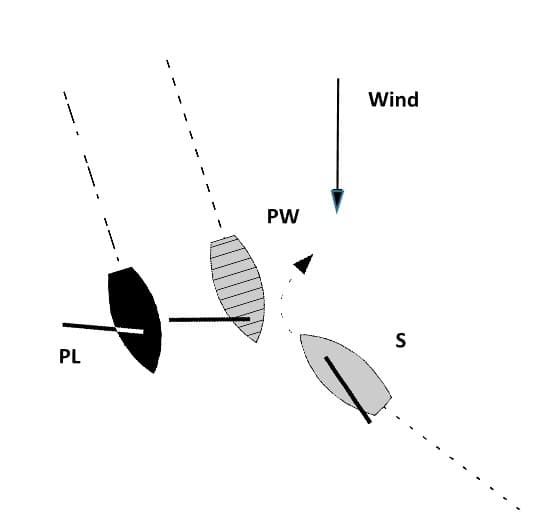
In a moderate to rough sea and a fresh breeze, S, close-hauled on starboard tack on her proper course, converged with PW and PL, overlapped and broad reaching on port tack on a different leg of the course. The rigging of PW and S touched, in spite of S luffing sharply in an attempt to avoid the contact. There was no damage or injury.
Two protests arose from this one incident and were heard separately. In the first protest, S vs PW, the latter was disqualified under rule 10. The facts found in that hearing did not mention PL. During the hearing of the second protest, PW vs PL, PL stated that she knew that S was converging with PW and PL, that PW would be likely to need room from PL to avoid a possibly serious collision, and that the situation was developing rapidly. PL was disqualified under rule 19.2(b) for not giving PW room between her and S, an obstruction. PW appealed the decision of the protest committee disqualifying her for breaking rule 10.
Decision
In cases of this kind, the two protests should, as permitted by rule 63.2(b), be heard together in the presence of representatives of all the boats involved. This ensures that all of them hear all of the testimony given to the protest committee about the incident, as required by rule 63.1(a)(4). Had this procedure been followed, the protest committee would have learned that the collision between PW and S arose from the inability of PW to bear away because PL did not give her room to do so as required by rule 19.2(b), and PW was therefore exonerated by rule 43.1(b) for breaking rule 10. PL also broke rule 14(b).
Although there was contact between S and PW, neither broke rule 14(a) because (i) after it became clear that PW was not going to keep clear of S, it was not possible for S to have avoided the contact, and (ii) after it became clear to PW that PL was not going to give her the room to which she was entitled, it was not possible for PW to have avoided the contact.
S interfered with PW, a boat on another leg, but S did not break rule 23.2 because she was sailing her proper course.
PW’s appeal is upheld. Because PW is exonerated by rule 43.1(b) for breaking rule 10, she is to be reinstated. The protest committee’s decision to disqualify PL for breaking rule 19.2(b) was correct.